
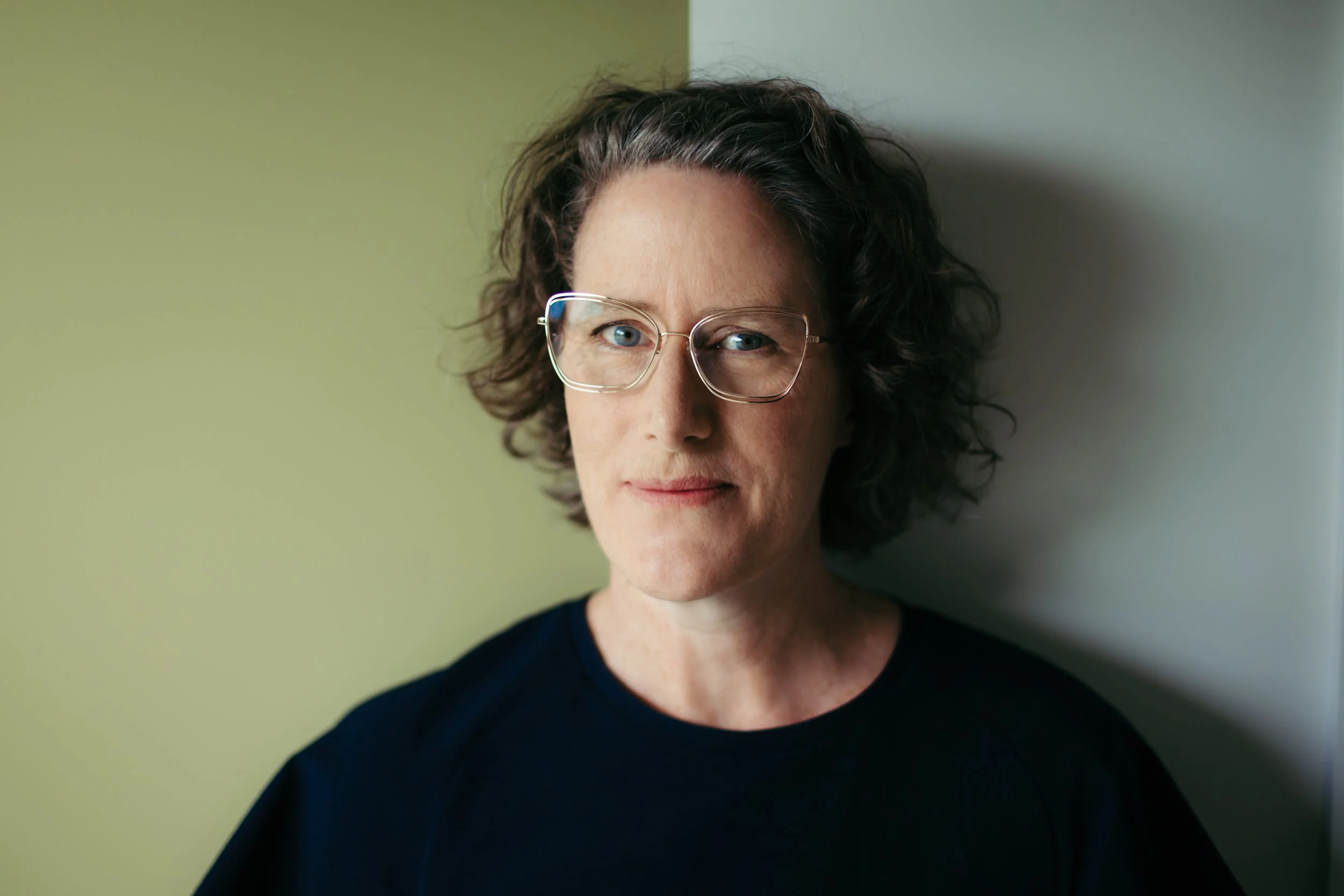
Photo by Ebony Lamb
Kate Camp is the award-winning author of many acclaimed collections of poems, including The Mirror of Simple Annihilated Souls (winner of the 2011 NZ Post Book Award for Poetry), How to Be Happy Though Human: New and Selected Poems (2020) published in New Zealand and Canada, and Makeshift Seasons (2025). Her “scorchingly good” memoir, You Probably Think This Song Is About You, was published in 2022. Her latest book is Leather & Chains: My 1986 Diary, a hilarious and heartbreaking journey through the rollercoaster entries of her teenage diary.
As we see in Leather & Chains, you’ve been committed to writing — in different forms — from a young age. When did you know you wanted to write?
As a kid I used to write poems for people’s birthdays, and I have teenage poetry going back to not long after the diary. I’m not sure I really formed an idea of writing for publication until I realised – maybe around age 20 – that a girl from my school, Emily Perkins, had published some short stories.
I went to university young, at 16, dropped out after a year, then went back when I was 21. It was then I decided I would apply for the creative writing course at Victoria. My plan was to apply three times and if I didn’t get in, then I’d just give up. I got in on the first application, and that was a life-changing moment for sure.
You refer to various genre conventions and literary figures (e.g. Samuel Pepys, Jane Austen, Hunter S. Thompson, the Victorian novel, Beat poetry) throughout your response(s) to The Diary in Leather & Chains. To what degree would these have been conscious choices to emulate, imagining another eye on The Diary? Can you remember particular formative texts for you during this period?
I was reading so widely as a young teen, from Flowers in the Attic through to Julian Barnes, and had metabolised a lot of the English canon by osmosis from my English teacher mother, so it was all a bit of a mash up I think. I reckon Go Ask Alice and Puberty Blues would have been direct influences, not just on the diary, but on my actual behaviour.
As I was writing Leather & Chains the book I leaned on was Mary Karr, The Art of Memoir – not as a model but as a pep talk, a touchstone, a bit of a bible. It was for my first memoir too.
How much do you feel you’ve retained the sources of inspiration you identify in The Diary? How has your pantheon of influences changed over the decades since?
Oh god who knows! I don’t really think about or notice influences, I just feel like everything I consume becomes part of my inner world, and that will eventually shape my writing.
In Leather & Chains, you outline the initial process for your written responses to The Diary: working in your parked car by the marina, post-morning sea swim, with a coffee from Raglan Roast, a page from The Diary on your phone, and your laptop on your knee. Does this routine resemble your general approach to carving out time and space for writing, or do you have another go-to practice? What does that look like?
Oh hell yes, I’m very much a carve out time person. For the last 20 years, while working full time, I’ve always negotiated to start my various jobs at midday on Wednesday, and Wednesday is my writing morning. However uninspired, stressed, busy or whatever I am feeling, I pretty much always stick to that routine: don’t check messages or socials, read poetry for an hour, write poetry for an hour, with an extra half hour to carry on if I want to.
It’s only an hour of compulsory poetry writing but sometimes it feels impossibly torturous. Among the little notes above my desk is a David Shrigley card: IT HAS ALWAYS BEEN MY DESIRE TO WRITE POETRY BUT I FIND IT INCREDIBLY FUCKING DIFFICULT. And then one by me, which I’ve had above my writing desks since I did the creative writing course in 1995: I ALWAYS HAVE TIME FOR MY OWN CREATIVE WORK.
I have my writing journals where I jot down notes of things that come to mind – just checked and the most recent one says the world is my Uber. On my writing morning I will look at the writing exercises on The Time Is Now (great online resource), and maybe read a chapter from Finger Exercises for Poets by Dorianne Laux, have a quick flick through the writing journal, and then start.
In this new book, as has been noted throughout coverage of your previous work, you demonstrate a characteristic wry wit. What is the role of humour in your work?
Humour is everything to me. It disrupts and it fuses things together, it enables so much nuance and complexity, because it acknowledges the gaps – between what you want and what you get, between what you expect and what happens. I see humour as necessarily subversive, but it’s also kind, I think, or at least I try to be funny in a kind way. It can sweeten things that are sad or impossible, and release tension, and bring people into connection.
But really that’s all theorising after the fact, which is that I am just a naturally comical person. I come from a family where being funny is highly valued so it’s in my DNA.
How did the book evolve from its original conception, from those daily responses to the final product?
I took a couple of chunks of time off work, about ten days each. During the first sprint I edited down the entries, choosing the ones that resonated most with me, and I wrote some essay text in response to having done that. In the second chunk of time I wrote the opening and closing essays.
As I explain in the book, the whole process was quite confronting and I felt very insecure about what I was doing. The other day I came across a little note I’d written to myself with some instructions to read each day, they included:
Don’t take things out.
Keep going into it, go deeper – or just go along.
Trust in the value of it.
Take care of the sentence / flow / memory – exhausts all the details and thoughts.
I really needed a lot of pep talks from myself as I was writing this book! Even more than usual. Because it seemed like such a niche, unimportant, self-indulgent project.
As a poet, essayist, and memoirist, you have an enviable ability to write equally fluently across different forms. How do you see these forms as interacting? Do you write both poetry and prose at the same time (as, indeed, the Kate of The Diary did)? How do you know which one you want to write a particular piece in?
Now with the two prose memoirs, I have actually covered quite a lot of territory in prose that I’d already touched on in poetry. In poetry you can be more honest in some ways, but less transparent. So for example, I wrote a whole chapter in my memoir about doing IVF, but it’s probably best summed up by the lines from my poem Kryptonite:
I personally walked away from hope some years ago
it was destroying me
like being rolled over
by a giant apple.
Is there a standout moment from your career thus far that you would love to go back and tell 1986 Kate about? (Would the Clive James anecdote make a Top 5 contender?)
Oh, definitely the Clive James moment. I mean, just having published books of poetry at all would be a huge thrill for 1986 Kate, and I’m sure she’d be impressed at having the residencies in Berlin and France.
But you know, 1986 Kate was all about what the boys thought, so I think she would have loved an early career moment, squeezing past two guys my own age (early 20s) in a packed reading at City Gallery. One of them said to his friend: ‘That’s Kate Camp!’ and his friend said, sounding super impressed, ‘Do you know her!?’ and the first guy replied, ‘No, but I’ve read her book and it’s really good.’
Do you have any advice for the young writers of today?
Write. Everything else is just stuff that isn’t writing.
Oh, and put your phone in another room.
What’s next in your writing life?
Poetry is always next, beyond that not sure. I have had an idea of doing a performance piece based on Leather & Chains so that could be fun.
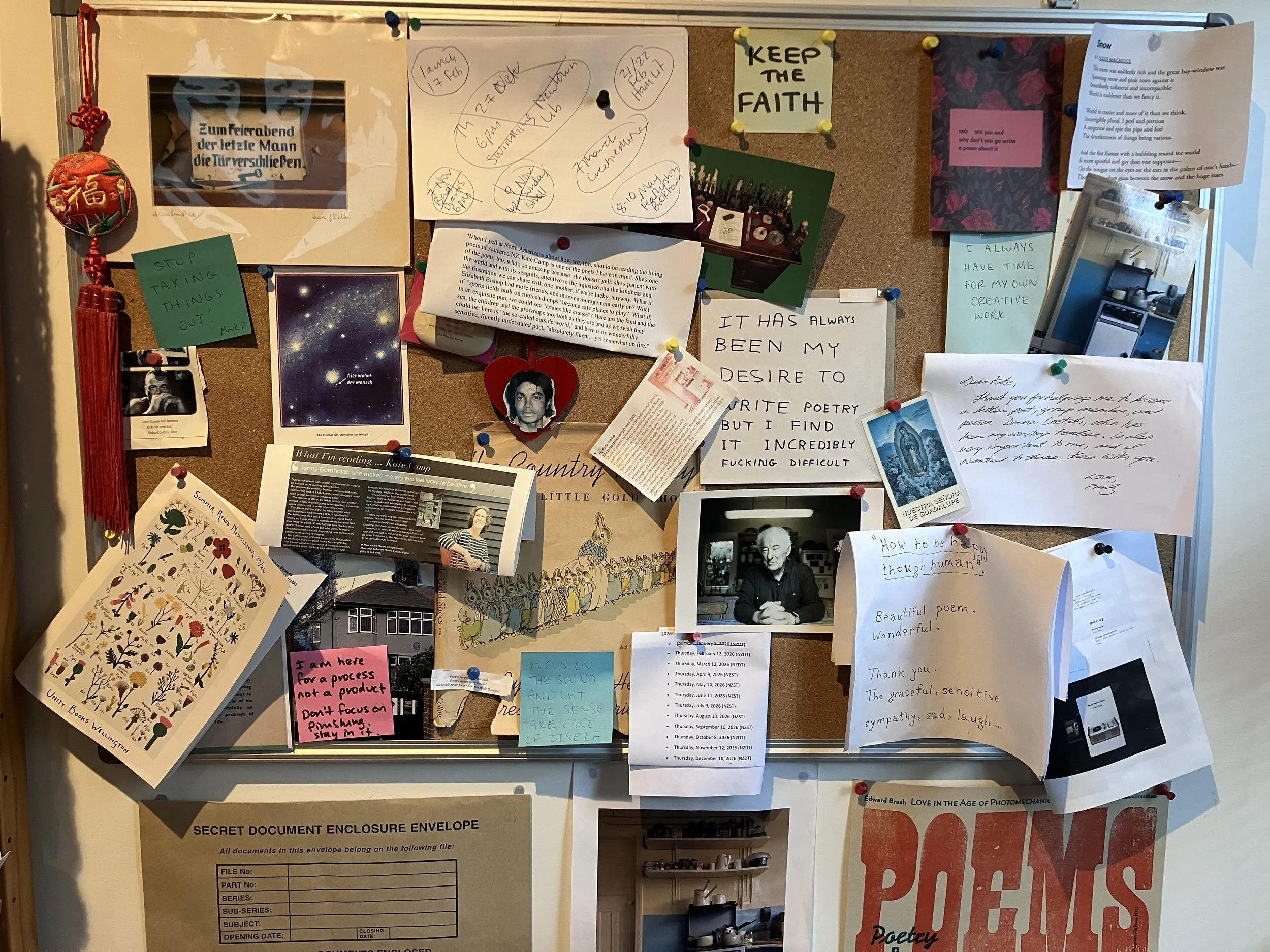
Kate’s desk noticeboard