
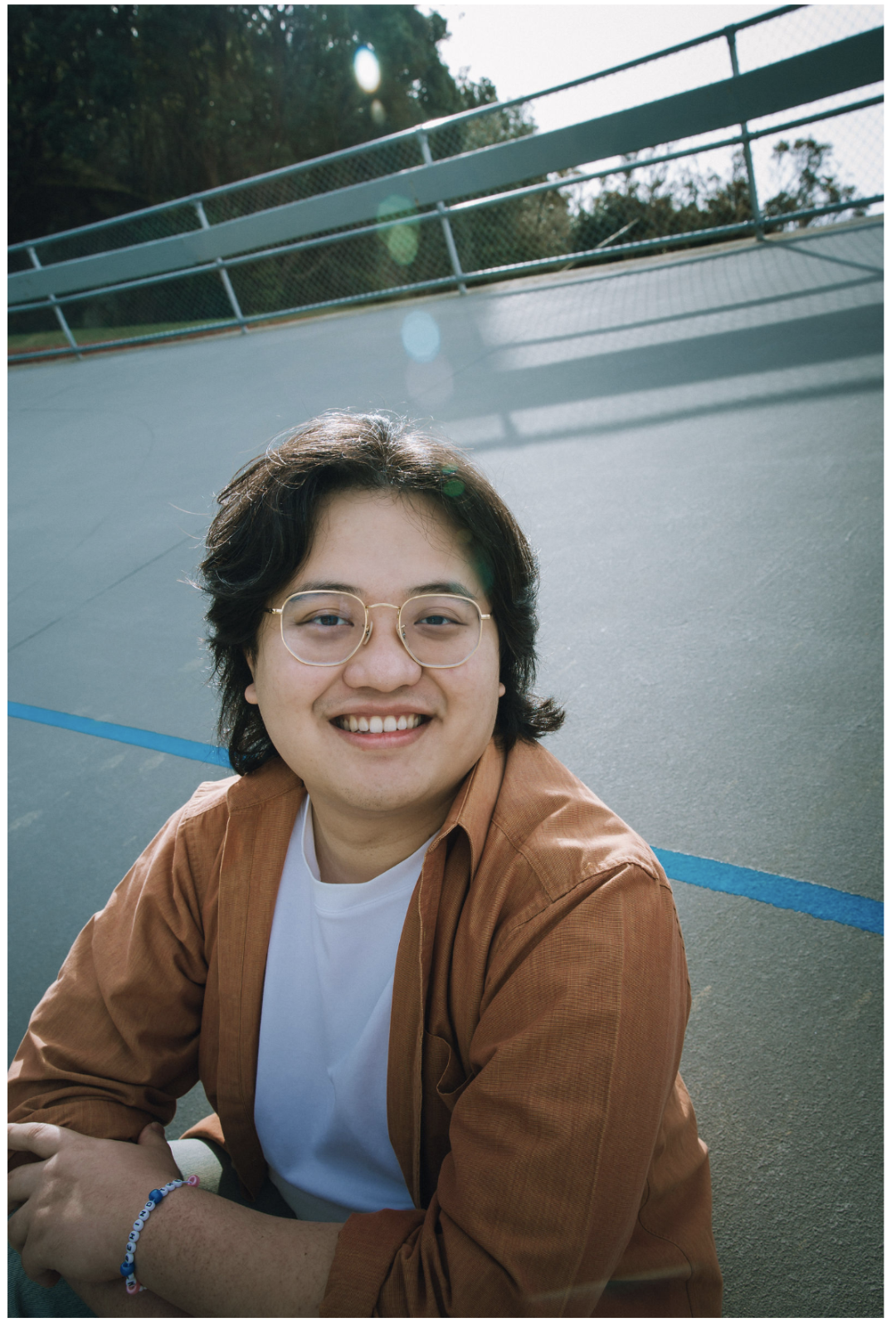
Photo by Ebony Lamb
Joseph Trinidad is a Filipino writer who lives in Te Whanganui-a-Tara Wellington. His work has been featured in Landfall, North & South, Te Papa, The Spinoff, Turbine | Kapohau and with Migrant Zine Collective. He was the winner of the 2023 Adam Foundation Prize from the International Institute of Modern Letters and the 2023 Asian Ink from Playmarket. His debut essay collection, Lucky Creatures, was awarded the inaugural Sarabande Prize in the Essay.
How did you come to start writing?
I didn’t start writing in English until I was 13, which was mostly cloying love poems verging on song lyrics and gothic sex scenes I was too young, too virgin to know anything about. I was 26 when I felt like my writing had properly matured, so I pursued studies and, when courage and open calls aligned, published to local journals.
I’m notorious for talking big game about my poetry and my plays, but really it’s the essays I know how to finish. Nothing is made up in non-fiction, no creative liberties to hide behind. It’s also about attention, my favourite tool. If you notice nothing, you’re already compromised — you might as well be dead and absent. Good thing I’m nosy and have a long memory.
We loved your recently released debut collection Lucky Creatures so much. Can you tell
our readers a bit about the book?
Thanks for loving the book. Never gets old to hear.
The book started as a rescue mission. Mami, my grandma, wouldn’t stay put during Covid. Somehow all our FaceTimes together, mostly me telling her to stop going to class reunions and taking group pictures, amounted to an essay, “How to Gut a Magnolia.” (Credit to Hattie Salmon, another Starling darling, for helping me to come up with that title!) The book took three more years to develop. Before I settled on Lucky Creatures, it was called Farming, then Magnolia, then Death Is Just Another Country. Some essays were removed and saved for another project; others were stripped for parts. Two essays were smooshed together, while one essay was broken apart and split. In the end, twenty-five drafts were reduced to thirteen polished essays. Throughout the process, the synopsis remained the same.
Lucky Creatures is about my family’s migration from the Philippines to Aotearoa. It’s told through a series of essays that includes all my favourite themes: sex, death and money by way of my favourite people: farmers, Filipinos and fags.
Which writers or works have been particularly formative for you? Can you trace any of those lineages or influences in Lucky Creatures?
Lucky Creatures is part of a particularly Wellington lineage of full-length non-fiction collections: Ashleigh Young’s Can You Tolerate This? and Rose Lu’s All Who Live on Islands. I’d also include Lana Lopesi’s Bloody Woman here. (BWB is based in Wellington, too, right?) These books are heavy on insights. There’s a muscular grip on prose and theme that, even after all these years, is still refreshing to come back to. Filipinx non-fiction writers also had a profound effect on me. I’d cite Elaine Castillo’s How to Read Now and Leanne Shapton’s Swimming Studies. Forget what you know about personal essays. Here are works where I was like, that one — that’s what I want to do.
What is it about the essay form that appeals to you? What do you think makes a good essay?
In a way, writing essays should be easy. You say what you want. One declarative sentence after another. You find ways to be eloquent and succinct. But in the many ways that set a good essay apart from a bad one, it can also be torturous and frustrating. I return to Vivian Gornick, who wrote, ‘What happened to the writer is not what matters; what matters is the large sense that the writer is able to make of what happened’. It’s easy to appeal to the masses: write a book that reinforces what they already know, so they can then feel good for reading it. But to me, a good work of non-fiction starts with three things: proactive inquiry, sustained research, and painful introspection. If the price of expression is craft, then the craft of the essay requires insight, and insight is easy to the ears but never obvious.
Lucky Creatures was the product of your MA at the International Institute of Modern Letters in 2023. What was that year like for you and how do you think it shaped your work?
The IIML is a school. You get what you put into it. You learn very quickly that there is very little use in comparing yourself to other students. I think about Annie Dillard’s advice: ‘Don’t compare yourself to your peers. Aim higher. Compare yourself to Edith Wharton. Aim there!’ I also learned that the biggest mistake is to act on every note you’re given — that’s one quick way to lose your voice. At some point, you come up with your own advice. A couple I had for myself: ‘Be friends with the poets’, ‘Even geniuses take inspiration from others’.
Your collection has also been published in the US by Sarabande Books — so exciting!
How did that opportunity come about?
It was my friend Maddie who pointed me to the Sarabande Prize in the Essay. To be honest, I initially found the suggestion a little ridiculous. I use my queer immigrant lens to write about small-town farming in the Philippines and New Zealand. Let’s just say I’m pretty niche. People told me already that for any New Zealand work to be published overseas is incredibly (read: unfairly) difficult. A few months after that lunch, I received an email saying that I won and that Sarabande was going to publish my book in the US with an introduction by Alexander Chee. Thank God for supportive and stubborn friends.
What does your writing practice and community look like, post-university?
Post-MA was the long winter of restructures and rewrites. The red pen. The best days were when I came to my desk with a clear head. The worst were when I’d rather binge Gilmore Girls in bed. Post-Lucky, I thought I’d relax, but I just found myself really bored. I needed a project. I signed up for an online class, illegally downloaded Roxanne Gay’s Masterclass episodes, and read and re-read a lot of craft books; a recent favourite is Elizabeth McCracken’s The Long Game. I got a nice keyboard and monitor from the publishing money, started new projects, and exercised (and disproved) things I’ve learned in writing my first book.
Lucky Creatures is a part of a recent surge of Filipino artworks in Aotearoa. I had the privilege to speak at the Wellington launch of Among Kinabuhi sa Aotearoa, landmark essays written by a fourteen-strong collective of Filipinos living in New Zealand, academics and artists spearheaded by Marco Conaco and Vivien Beduya. There’s also Abigail Legg’s Kababayan, the fall-to-your-knees incredible portraits of her titas in Feilding; Jas Sabrine and Gia Espelita’s Agos ng Kamay, a baybayin workshop; and the Filipino-Kiwi queer collective, BAKLA, that just closed its bakla af showcase at Thistle Hall. What a distinctly fortuitous time to publish my work in Aotearoa. I knew I wasn’t alone; it feels so good to be right.
My family is annoyingly pleasant about the book, too. The things that they’re hung up about are not the ones I expected. My grandmother wanted five copies of the book and all the working manuscripts. My mother was a little irked about me publishing her gauche observations of the white people at her local Countdown. There’s a line in there that’s something like, ‘They’re wearing such short shorts, you can almost see their groin.’ The best reaction was from my little cousin Riley, who sent me a video about her chapter. She just began to read, and she loved seeing herself in a book.
Do you have any advice for emerging writers working in Aotearoa today?
I’ll start with something practical. Find ways to put your work out there. My big concern for emerging writers right now is that there aren’t enough places to publish creative non-fiction in Aotearoa. One podcast I did recently pointed out that none of the periodicals I’ve published in are familiar to American ears: Migrant Zine Collective, North & South, Landfall. I wanted to correct them and say, I mean, they’re also not familiar to my parents, who have lived here for twenty years. Aotearoa has limited spaces for creative non-fiction, and those spaces are only becoming smaller. Of the publications I mentioned, Landfall is the only one still publishing full-length literary essays. I’m scared that we’ll lose swathes of writers because the opportunities to publish are shrinking. Even an encouraging rejection letter can keep an emerging writer going. It’s not all bad, though. You can submit your essays to E-Tangata, takahē and Turbine | Kapohau, or join the many excellent Kiwi essayists exiled to Substack. Or, if you’re feeling particularly nostalgic, scroll through Pantograph Punch and learn from our digital forebears. It’s dire, but the landscape isn’t completely lost.
My other advice is to read widely. There are universal truths held even in the most specific experiences, and no one knows that better than a reader who reads beyond the parameters of what they accept to be true.
What’s next for you?
I’m working on a new essay collection about immigrant fathers. This one is noticeably harder already, a little darker, too, maybe. My father has built a life he soon might not be able to afford. New Zealand farmers like him face the rising cost of dairy production in an already volatile market. When do farmhands retire? Will they ever? But then again, she’ll be right. Hawke’s Bay doesn’t lump this trouble-sized courage with carelessness or Band-Aid fixes. Instead, it’s a particularly Antipodean reminder that the universe favours those who see opportunity in precarity, that people regularly eat thanks to the farm work of expert optimists. At the farm, ‘rural visionary’ is no oxymoron. Greener pastures were once hope, elbow grease, and seeds in freshly sowed land. I’m looking forward to continuing what I started with Lucky Creatures. I knew my first book was done when no more body bags came out of my past, when I could hear the call of my favourite creatures nearby. What creatures will my attention reanimate this time?